Optimization is the key to increasing profits in affiliate marketing campaigns.
You might have the highest-converting landing page and ad creatives — but competitors can easily “steal” them using spy tools.
But what about your optimization process?
That part is yours alone.
No one else can truly see it.
In this article, we’ll talk about how to optimize affiliate campaigns and turn losing campaigns into profitable ones.
Why Campaign Optimization Matters in Affiliate Marketing
Campaign optimization is one of the most important profit-making skills in affiliate marketing.
Have you ever launched a campaign, lost money, and had no idea what to do next?
That’s where optimization comes in.
The goal is to turn a money-burning campaign into a money-making machine.
Because when you first launch a campaign, all you really have are theories and assumptions.
You can guess what customers want — but you don’t truly know until you have enough data.
And in most cases, new affiliate campaigns lose money at the beginning.
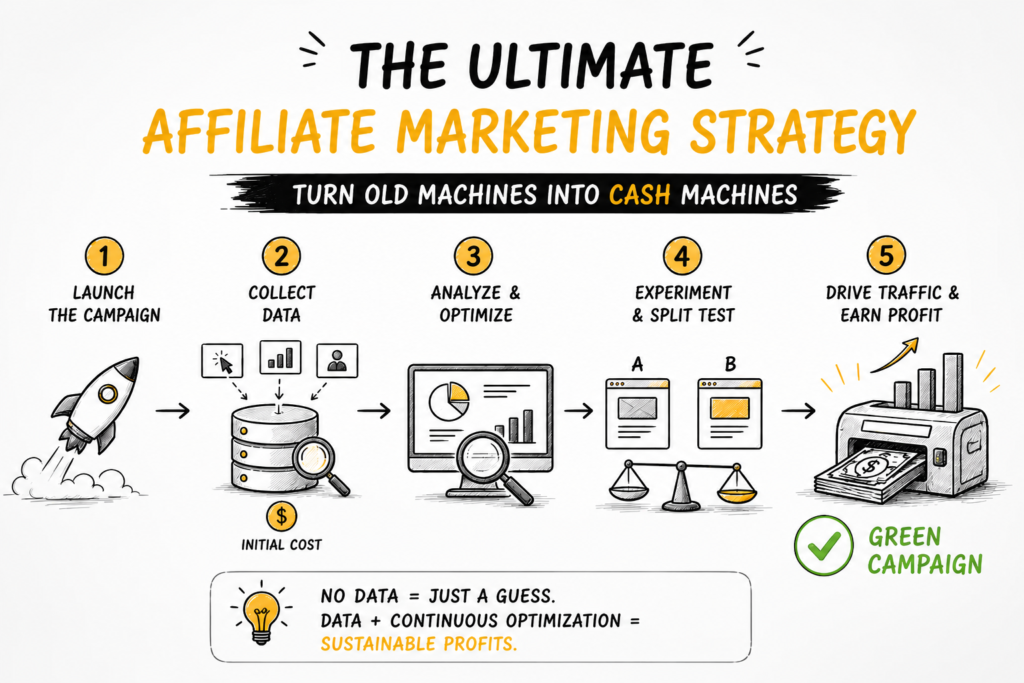
The usual process looks something like this:
- Launch the campaign
- Spend some money collecting data
- Optimize based on the data
- Run experiments (also known as split tests)
- Improve the campaign step by step until it becomes profitable
In the affiliate world, we often call a profitable campaign a “green campaign.”
Think of it like learning how to sell cars.
Imagine you’re a beginner salesperson constantly making mistakes.
Does struggling at first mean you’ll fail forever? Of course not.
You gain experience over time.
You test different marketing approaches.
You experiment with how you dress when meeting customers.
You compare a more aggressive sales style versus a softer, question-based approach.
The key to improvement is testing.
And affiliate marketing works the exact same way.
You Need a Real Optimization Process
(Not Random Testing)
One of the biggest mistakes beginners make is launching a campaign and expecting instant profits.
When you first start running ads, losing money is normal.
But instead of thinking, “I’m losing money,” think of it this way:
- You are paying to collect data.
- You’re buying clicks to understand what customers actually want.
Affiliate campaigns are built — not magically discovered.
The problem is that many beginners test random things without any real system behind it.
And that creates two major problems.
1. You Don’t Actually Learn Anything.
Even if you make money, it may just be luck.
Without a structured optimization process, you won’t truly understand why the campaign worked.
And if competitors steal your landing page or ad creatives, you won’t know how to rebuild the success.
2. You Become Average at Everything
In almost every niche, a small percentage of affiliates make most of the money.
It’s basically the 80/20 rule.
A tiny group dominates because they go deep, improve their systems, and continuously optimize.
But if you keep jumping from one random test to another, you’ll never reach that level.
Some of my biggest campaigns actually started out unprofitable.
But I kept testing, optimizing, and improving them until they eventually became profitable.
One important note:
Only continue testing if the campaign still shows potential.
If the campaign clearly has no future, then no amount of optimization will save it.
You also need to know when to stop.
A Simple Example of Affiliate Campaign Optimization
Optimization is the process of testing different parts of your campaign.
With every test, you learn more about what customers actually want — and over time, that’s how campaigns become profitable.
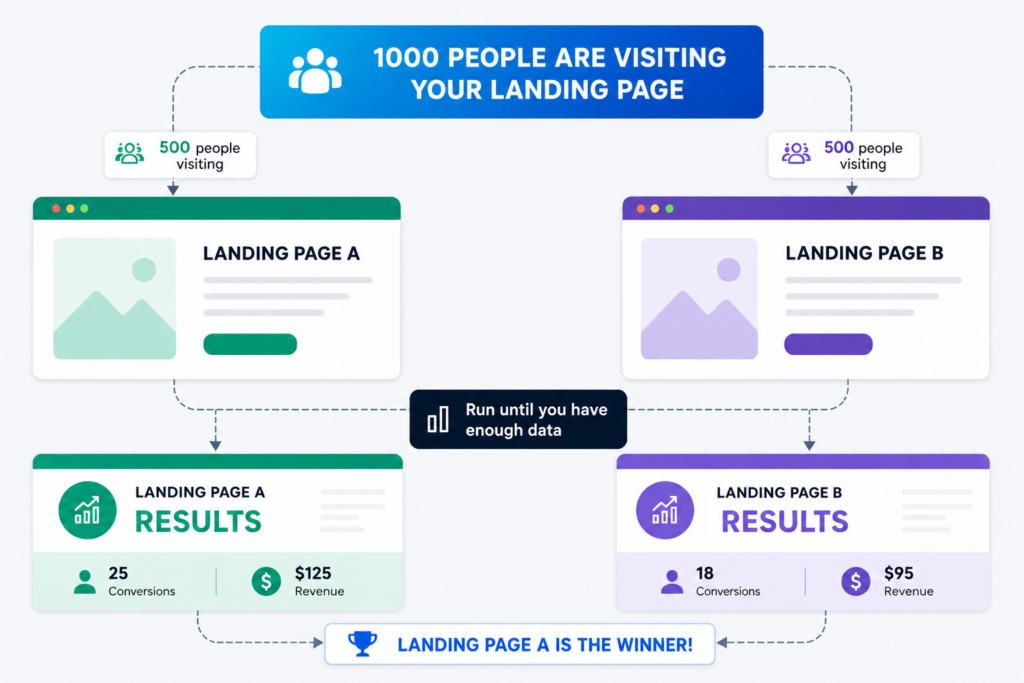
For example, let’s say you send 1,000 visitors to two different landing pages:
- Landing Page A: 25 conversions, $125 revenue
- Landing Page B: 18 conversions, $95 revenue
In this case, Landing Page A is the winner.
Now the next step is important:
Compare Landing Page A with Landing Page B and ask yourself:
- Why did A perform better?
- What made visitors convert more?
- Was the headline stronger?
- Was the design cleaner?
- Did the page feel more trustworthy?
By analyzing the differences, you gain valuable insights.
And those insights are what help you improve future campaigns.
Top 3 Principles for Optimizing Affiliate Campaigns
Next, I’m going to share 3 important principles you should understand when optimizing affiliate campaigns.
Everything here comes from my personal experience.
Over time, as you run more campaigns and analyze more data, you’ll develop your own optimization style and instincts as well.
1. As a Beginner, Test One Thing at a Time
Think of affiliate marketing campaigns like scientific experiments.
There are many variables involved.
And if you test too many things at once, you won’t know which factor actually made the difference.
That’s why beginners should keep things simple.
Start by testing only the offer.
Once you find the most profitable offer, then move on to testing landing pages while keeping everything else the same.
Here’s a simple example:
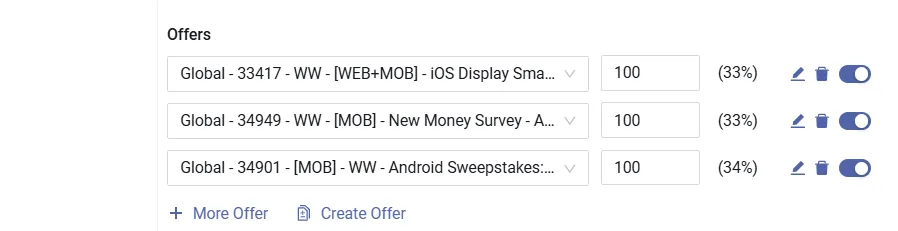
You place multiple offers inside one campaign, and your tracking tool automatically rotates traffic between them randomly.
This allows you to compare performance more accurately and identify the winning offer based on real data.
Once you become more experienced, you can start testing multiple variables at the same time.
2. Make Sure Your Data Is Statistically Significant
Imagine flipping a coin and getting heads 3 times in a row.
Does that mean the coin will always land on heads?
Of course not.
If you flip it enough times, the results will eventually get closer to 50/50.
That’s what statistical significance is about — collecting enough data before making conclusions.
The same principle applies to affiliate marketing.
You should avoid making decisions too early.
For example:
- Landing Page A: 500 clicks and 3 conversions
- Landing Page B: 500 clicks and 5 conversions
Does that automatically mean Landing Page B is better?
Not necessarily.
It could simply be luck.
If you continue sending traffic, Landing Page A might eventually outperform B.
That’s why you need enough data before deciding on a winner.
So how much data is “enough”?
Usually, affiliates use A/B testing calculators.
You can search Google for terms like “A/B Testing Calculator” and use one of the available tools.
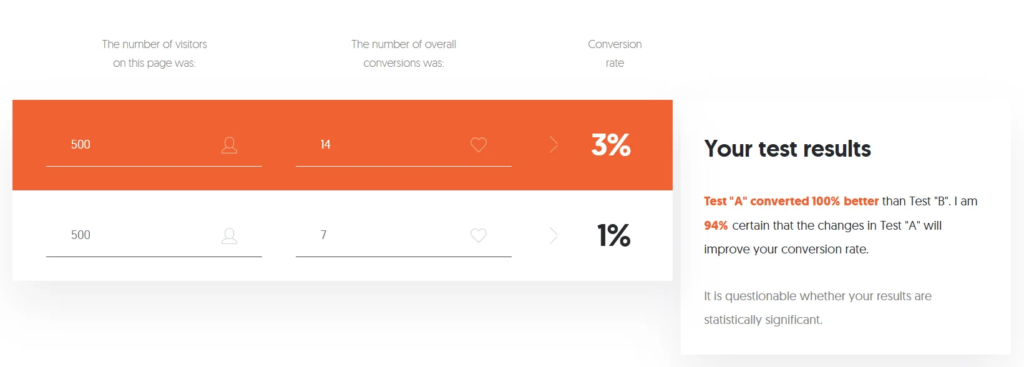
Simply enter:
- Number of visitors
- Number of conversions
The tool will estimate which variation performs better and how confident the result is.
In affiliate marketing, the common confidence levels are:
- 95% confidence → strong enough to make a decision
- 90% → acceptable, but less reliable
- 99% → extremely certain
Most affiliates are comfortable making decisions around the 95% confidence level.
For example, if your test shows a 94% confidence level, that’s usually already good enough to conclude that one landing page is outperforming the other.
3. Focus on the Factors That Create the Biggest Impact
Does the color of your CTA button matter?
Maybe.
But will changing the button color have a bigger impact than changing the headline?
Probably not.
Because headlines usually have a much larger influence on conversion rates.
That’s why you should focus your attention on the elements that create the biggest impact inside your campaign.
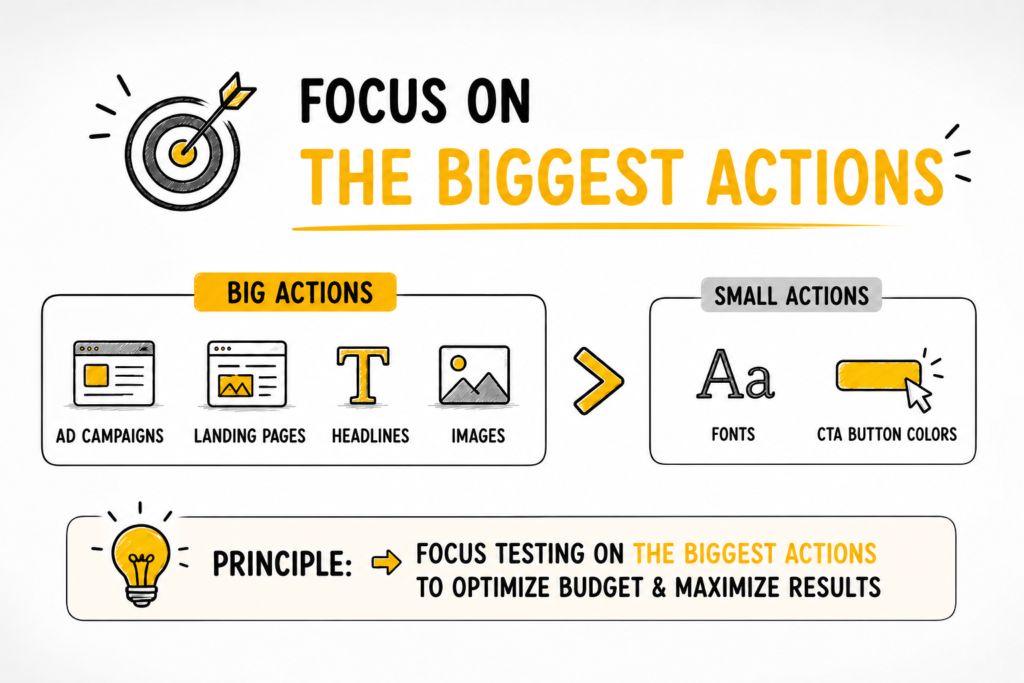
High-impact elements:
- Ad creatives
- Landing pages
- Headlines
- Images
Lower-impact elements:
- Fonts
- CTA button colors
- Small design tweaks
The more budget you have, the more things you can afford to test.
But when your budget is limited, you need to spend your money carefully.
Don’t waste traffic on low-impact experiments.
Think about it.
Let’s say your affiliate marketing budget is $300 per month.
- Tracking software costs $99/month
- Your server costs $50/month
Now you only have about $150 left for buying traffic.
And if your CPC is $1 per click, that means you only get 150 clicks.
That’s not much data to work with.
In situations like this, you have a few options:
- Find cheaper traffic sources to reduce CPC
- Increase your budget to buy more clicks
- Focus only on testing the highest-impact elements
- Or reduce your operating costs by using cheaper tracking tools and cloud-based hosting solutions
These are the kinds of things that can make a huge difference when you’re working with a small budget.
Examples of Testing Campaigns in Affiliate Marketing
Different traffic sources require different testing approaches.
The way you optimize a campaign on one platform may not work the same way on another.
Below, I’ll share two simple examples to help you understand the overall testing mindset and process.
The goal here is not to give you a rigid formula, but to help you understand how experienced affiliates think when optimizing campaigns.
In real-world situations, you’ll still need to adapt based on the traffic source, market conditions, and platform updates — because traffic platforms constantly change over time.
Example #1: Testing an Affiliate Campaign with Facebook Ads
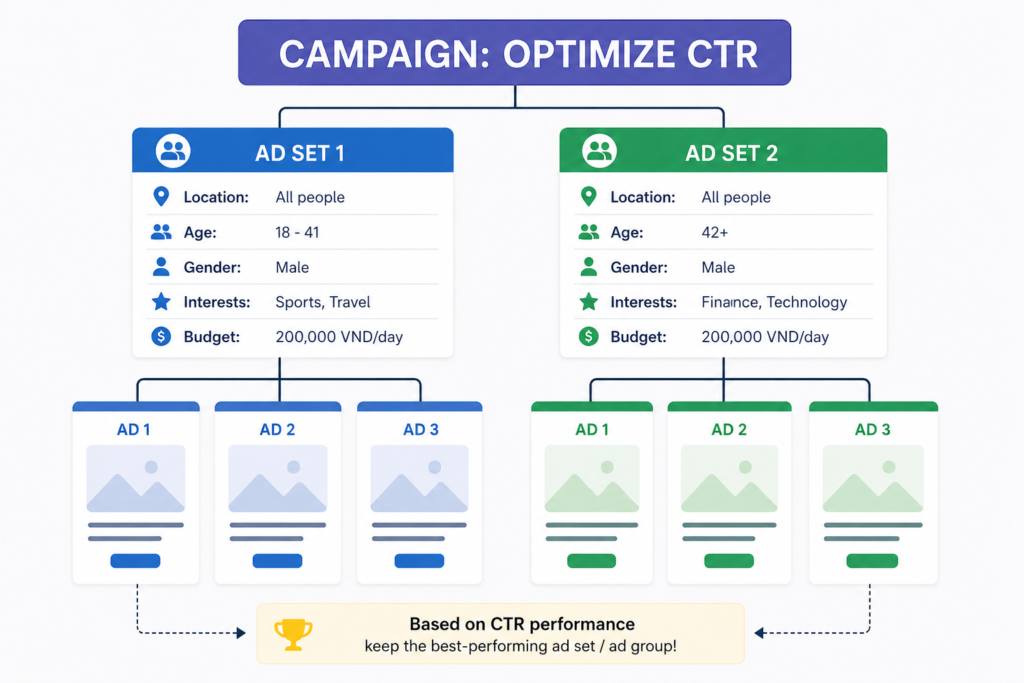
Which Age Group Should You Target?
Let’s say you’re promoting a product on Facebook and want to find out which age group generates the highest profit.
In this case, you could start by targeting:
Men, ages 18–65.
Then, based on each age group, you create different advertising angles — and sometimes even different landing pages.
For example, if you’re promoting a nutrition product:
- Ages 18–24
“Boost your natural energy and stay productive throughout the day.” - Ages 35–45
“Feeling tired and low on energy? Restore your vitality with the right nutrition.” - Ages 45–65
“Support your daily health and maintain a stronger, more active body.”

Now let’s say you run the campaign and discover that the 45+ age group generates the highest profit, while the other groups perform poorly.
At that point, the next step becomes obvious:
- Focus more heavily on that winning audience.
- Create additional ad creatives for them.
- Test more landing pages.
- Increase the ad budget to drive more traffic.
See?
Campaign optimization is often much simpler than people think.
Example #2: Testing Ads in Mobile Campaigns
Mobile advertising is a completely different environment compared to Facebook or Google Ads.
There are many additional variables you can test, such as:
- Operating systems: Is Android or iOS more profitable?
- Browsers: Does Chrome perform better than UC Browser?
- Connection types: Do users on 4G convert better than users on Wi-Fi?
For example, let’s say I’m running an affiliate campaign promoting a VPN app.
Whenever a user signs up for a free trial, I earn a commission.
When launching the campaign, I would initially target both Android and iPhone users.
After collecting data, I might discover that Android users are generating much higher profits.
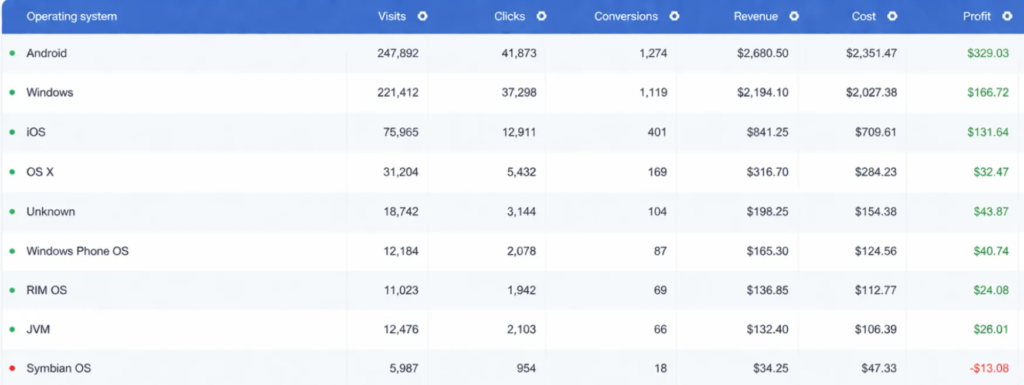
At that point, I would pause traffic from unprofitable devices or operating systems and focus more heavily on the winning segment.
That’s essentially an operating system split test.
And there are countless other ways to test and optimize campaigns.
If you look closely at the variables available inside your tracking tool, you’ll usually find clues about what to test next.
When starting mobile campaigns, I recommend focusing on 3 core variables:
- Testing different offers
- Testing different landing pages
- Testing different ad creatives
In my experience, these are the three most important variables in almost every affiliate campaign.
How much you can test ultimately depends on your budget.
If you’re a beginner, you may only have enough budget to test 2–3 offers before running out of money.
Professional affiliates, on the other hand, can afford to test dozens of offers because they have more capital and stronger systems.
And the more offers you test, the higher your chances of finding a profitable winner.
But when your budget is small, you need to work much more carefully and strategically.
Key Variables You Can Optimize in Affiliate Campaigns
I hesitated a bit before including this section because I don’t want beginners to feel overwhelmed.
But I also think it’s important for you to understand the bigger picture and know what the long-term goal looks like.
When you’re just starting out, even a campaign with a -50% ROI can actually be a good sign.
Why?
Because at least it shows potential.
It means the campaign is getting some traction, and with proper optimization, you may eventually turn it into a profitable campaign.
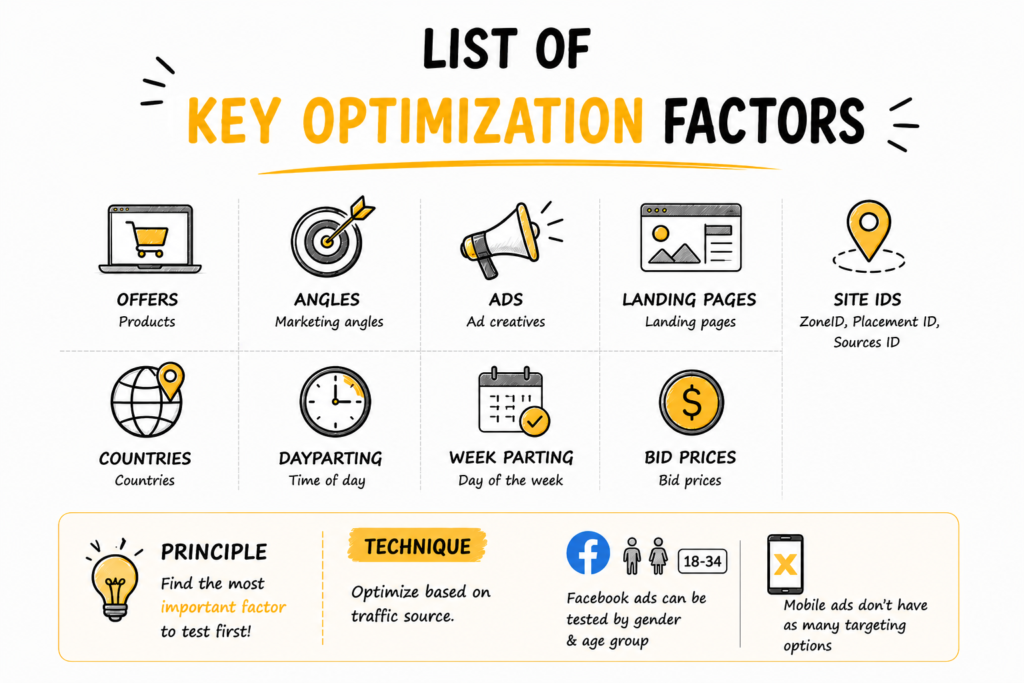
Below are some of the most important variables affiliates commonly test and optimize:
- Offers — the products or services you promote
- Angles — the marketing approach used to attract users
- Ads — your ad creatives
- Landing Pages — the pages users see after clicking the ad
- Site IDs (also called Zone IDs, Placement IDs, or Source IDs)
- Countries — target geographies
- Dayparting — the most profitable times of day
- Week Parting — the most profitable days of the week
- Bid Prices — how much you pay for traffic
Your job is to identify which variables matter most and prioritize testing those first.
One important thing to understand:
Your optimization strategy depends heavily on the traffic source you’re using.
For example:
With Facebook Ads, you can test demographics such as gender and age groups.
But in many mobile traffic sources, those targeting options may not even exist.
Final Thoughts
In this article, I’ve shared quite a lot of concepts and strategies with you.
Theory is important — but the real learning only begins once you start running actual campaigns yourself.
For beginners, all of this information may feel overwhelming at first.
But I also know that for many people, discovering these ideas is exciting — because it finally gives them a clear path into the world of online business.
- Plan carefully.
- Prepare properly.
- Then take action aggressively.
That’s how real progress — and real success — happens.